
The Cost of “Just Get It Done”
(Especially Before JPM)
Back when I was first learning how to do Western blots as a PhD student, I had to go on the hunt for antibodies for my experiments. And as a relatively new scientist who didn’t yet know which suppliers had a great reputation (and which ones decidedly did not), I thought I’d hit the jackpot when I stumbled upon one vendor in particular (that rhymed with “Fanta Snooze….”).
They seemed to have an antibody for everything. Whatever protein I was looking for, whatever marker I needed, whatever weirdly specific host species I wanted it raised in, they probably had it. Better yet, it was usually in stock, could be on my bench within a few days, and the price was usually at least half of what other vendors offered.
Hell yeah.
Then I actually tried using the antibodies. My Western blots usually looked like hot garbage. Once in a while there was a beautiful fat band exactly where it was supposed to be. Sometimes there’d be six bands. And sometimes it looked like a Rorschach ink blot.
Eventually, I learned what plenty of scientists before me already knew. Having the antibody you need, when you need it, at a price your lab can stomach doesn’t mean much if the antibody doesn’t work worth a damn.
Looking back, it was one of my earliest lessons in a tradeoff I still encounter all the time.
Speed comes at a cost.
You’ve probably heard some version of the cheap/fast/good triangle, where you can just pick two. Want something fast and good? Sure, but expect to pay for the resources required to make that happen. Want something good while keeping an eye on budget? Also doable, if people have enough time to plan and execute it well.
Turns out, “we made it” and “we made it well” are two different things.
—
 Fast forward 12 years. I’ve retired my pipette, but I still see versions of the same tradeoff in branding and science communications. Only now, instead of antibodies, it’s messaging. Websites. Corporate decks. Brand identities. Scientific animations. Photography. PR campaigns.
Fast isn’t inherently bad. Sometimes fast is necessary, especially in biotech where things can move at breakneck speed. But when given time, we have the breathing room to really drill down into the science. See what competitors are doing. Read the literature. Talk to your team and other stakeholders. Play around with different directions. Create something, realize it doesn’t quite hit the mark, throw it out, bang our heads against the wall a bit, and come back with something better.
That process is how we get beyond simply making something that looks or sounds good to creating something that truly captures what makes your company different and gives your audience a reason to remember you.
But when timelines get squeezed, that exploration is often the first thing we have to sacrifice.
Which brings us to one of my favorite annual examples – the J.P. Morgan Healthcare Conference.
Every year, somewhere around mid-November-ish, it starts. A company realizes JPM is coming, and the list begins. The corporate deck needs a facelift, the website doesn’t quite reflect where the company is anymore, there’s new data to incorporate, or there’s a big flashy news announcement to make at the conference.
January is almost two months away. Plenty of time, right?
Right?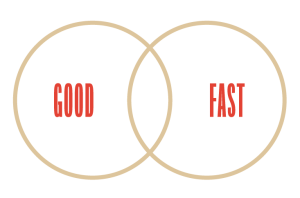
Except a “small deck refresh” becomes a narrative rethink because the story isn’t landing anymore. That changes the copy and the visual approach. Oops, the website is still telling the old story, so that needs attention, too.
And then come the reviews. Leadership weighs in. Scientists weigh in. The board weighs in. Legal would also like their two weeks, thank you very much.
We’re also fighting against Thanksgiving and holiday season PTO. Suddenly, those “almost two months” have approximately eleven usable working days in them.
And that’s where originality starts to disappear.
Can we build a great deck quickly? Absolutely. Can we overhaul a website on a compressed timeline? Yep. Sometimes that’s exactly what the situation calls for. But when the goal becomes just “get it done by JPM,” there’s less room to play with ideas and try something unexpected. As a result, we tend to fall back on what’s familiar—the “we’re changing the treatment paradigm” language, the blue/green color palettes, the tried-and-true deck structures. They get the job done, sure, but they can also make your company look and sound like every other biotech out there.
 The problem is that JPM might be one of the worst possible places to show up looking and sounding like everyone else. For one week in January, an absurd percentage of the biotech industry descends on a few blocks of San Francisco. Companies are shoulder-to-shoulder competing for the same investors, partners, media attention, and meeting slots. People are practically fighting over broom closets because they’re the only meeting spaces left.
Companies spend a lot of money just to be in that chaos. So if there’s ever a moment when it pays to give someone a reason to remember you, this is it.
If you want something that feels unmistakably like your company, something that makes someone stop for a second, pay attention, and maybe even remember you after they’ve seen their 14th deck of the day, you need to give yourself room to find it.
This isn’t just about JPM, either.
Whether you’re preparing for a financing round, a company launch, a major data readout, a conference, or any other moment when you need people to pay attention, give the work time to come to life.